
Are We Teaching Mathematics… or Just Teaching Steps?

“Miss, will this be in the test?”
It’s a question every mathematics teacher has heard. And, if we’re honest, it’s a question that often reveals how many learners experience mathematics. They see it as a collection of formulas, rules and procedures to memorise rather than a connected body of ideas to understand.
But what if we changed the question?
Understanding before memorising
Mathematics is unlike many other school subjects. Each new concept builds on previous knowledge. When learners have gaps in their understanding, those gaps grow into barriers that make later topics increasingly difficult.
For years, mathematics education focused heavily on procedures:
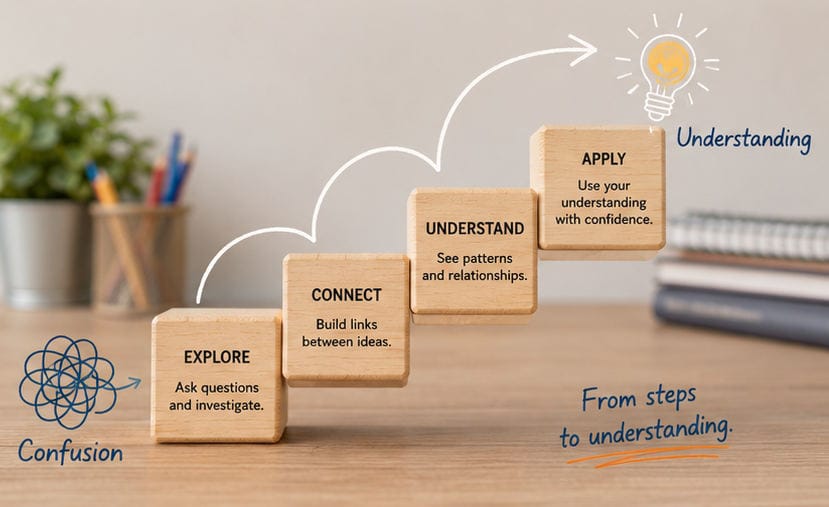
While procedural fluency is certainly important, it is only one part of mathematical proficiency.
Learners also need conceptual understanding – the ability to recognise relationships, explain their thinking, and understand why mathematical procedures make sense.
The real power of mathematics comes when conceptual understanding and procedural fluency work together.
It’s not either-or
One of the biggest misconceptions is that teachers must choose between teaching understanding or teaching procedures.
We don’t.
In fact, research consistently shows that the two strengthen one another.
When learners understand why a method works, they are more likely to remember it, apply it correctly in unfamiliar situations, and recognise when another strategy might be more efficient.
Likewise, practising procedures gives learners opportunities to reinforce the concepts they have learned.
The goal is not to replace procedures – it is to teach them meaningfully.
Four practical ways to strengthen understanding
Here are four classroom strategies that can make a real difference.
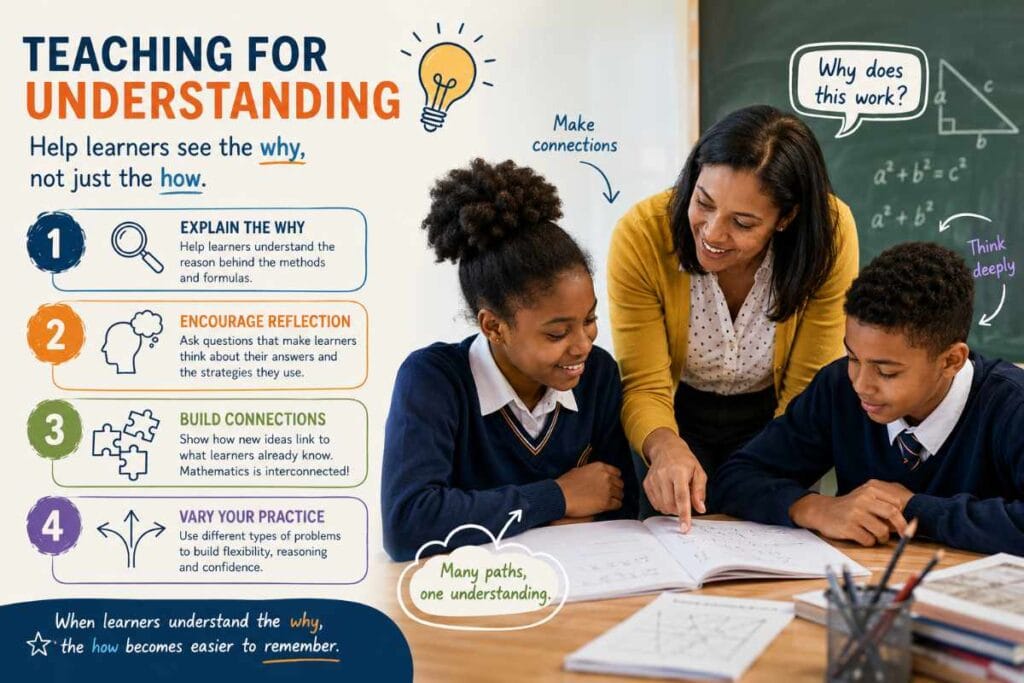
1. Explain the “why” out loud
As teachers, we often know why a method works, but we don’t always say it explicitly.
Take compound interest as an example. Rather than presenting the formula and expecting learners to memorise it, walk learners through how the amount grows year after year. Help them notice the pattern before introducing the formula.
When learners see where mathematics comes from, formulas become meaningful rather than mysterious.
2. Encourage learners to reflect
Reflection is one of the simplest and most powerful learning tools. Ask questions such as:
These questions develop mathematical thinking and help learners become more independent problem-solvers.
3. Build connections
Mathematics is beautifully connected.
Help learners see relationships between topics they have already studied and new ideas they are learning.
For example, showing the connection between area, volume and algebra allows learners to build a network of understanding instead of isolated pieces of knowledge.
The stronger these connections become, the easier future learning becomes.
4. Vary practice
Rather than giving twenty questions that all look the same, include a mixture of problem types.
Some questions should require learners to select the correct strategy themselves.
This kind of practice develops flexibility, reasoning and confidence – skills learners need both in examinations and in real life.
Teaching for understanding changes everything
When learners understand mathematics, something remarkable happens.
They begin asking better questions.
They explain their reasoning.
They recognise patterns.
Most importantly, they develop confidence because mathematics starts making sense.
As teachers, our goal should not simply be to help learners pass the next test. Our goal is to help them build mathematical understanding that will support them long after they leave our classrooms.
Every lesson gives us an opportunity to move beyond teaching steps and begin teaching thinking.
Because when learners understand the why, the how becomes far easier to remember.
Closing reflection
Perhaps the most rewarding moment in a mathematics classroom is not when a learner gets the correct answer – but when they can confidently explain why it is correct. That is the moment understanding has taken root, and that is the kind of learning that lasts.
Enjoyed this blog? This post is based on my article, Teaching for Understanding: How Concepts and Procedures Go Together, originally published in SUM IT UP!, the mathematics magazine of Oxford University Press (June 2026). If you would like to explore the ideas in greater depth, I encourage you to read the full article. (Link: https://oxford.co.za/oxford-maths/) (Pages 12–13)
